
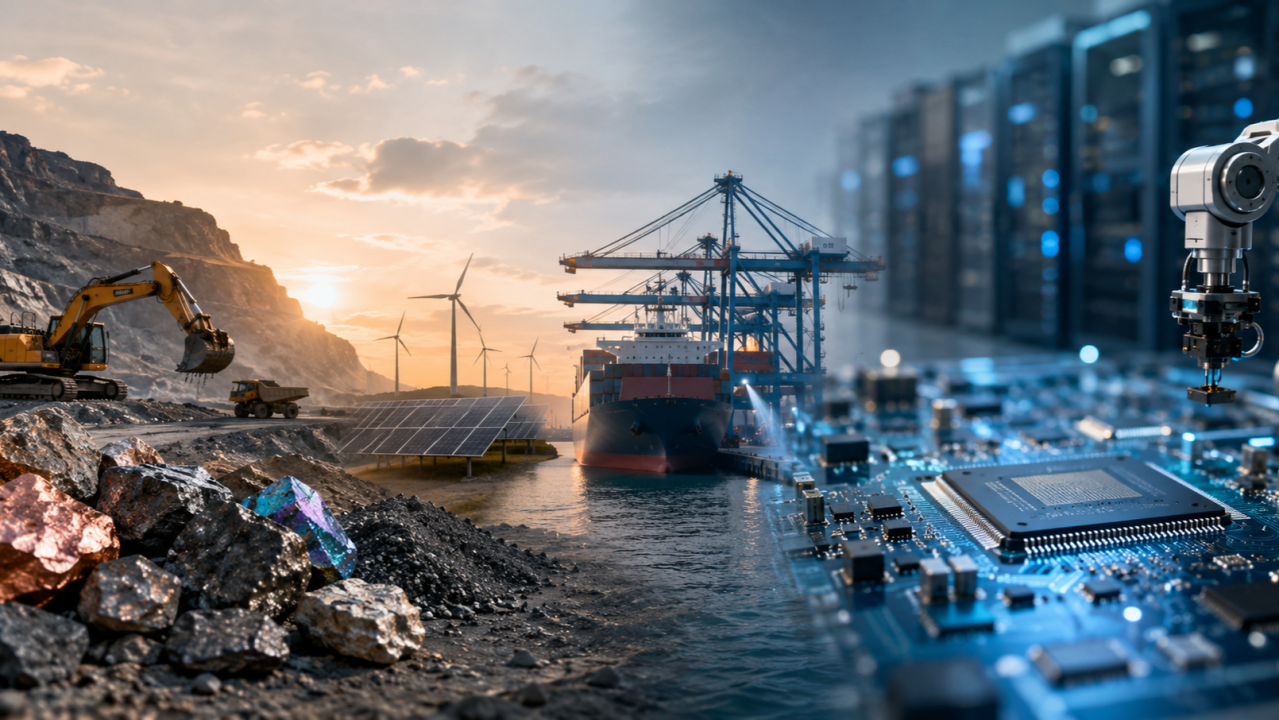
Who captures the value created by the resources that make the digital economy possible?

Introduction
The previous article in this series argued that digital sovereignty depends on much more than data. Artificial intelligence, cloud computing, digital services, and modern communications all rely upon layers of infrastructure and industrial capabilities that often remain invisible to the public. One of those layers begins beneath the ground. Digital technologies depend upon minerals, energy systems, manufacturing capabilities, and supply chains that support the entire digital economy.
The technologies shaping the twenty first century depend upon a relatively small group of minerals. Copper carries electricity through power grids, telecommunications networks, and data centers. Lithium, nickel, cobalt, and graphite support batteries and energy storage systems. Rare earth elements enable advanced electronics, renewable energy technologies, and many defense applications.
Without these materials there are no semiconductors, no data centers, no electric vehicles, and no artificial intelligence infrastructure. Another question therefore becomes equally important.
Who captures the value created by these resources?
The answer may reveal that economic and strategic power often resides far beyond the mine itself. Countries frequently celebrate discoveries of copper, lithium, cobalt, or rare earth elements. Large mineral reserves are often presented as pathways toward industrial development and national prosperity.
The answer, however, is more complex.
Owning resources is different from controlling value.
A mineral extracted from the ground still needs to be processed, refined, transported, transformed into components, integrated into products, and incorporated into increasingly sophisticated technologies.
At each stage of this process, value is added.
Knowledge increases.
Technological complexity increases.
Barriers to entry increase.
Economic returns often increase as well.
This creates an important distinction between the geography of extraction and the geography of value creation.
The countries that possess the minerals are not always the countries that capture the greatest economic benefits.
The countries that process materials, manufacture components, develop technologies, and integrate industrial ecosystems often capture a disproportionate share of the value.
The larger question is therefore not simply who owns the resources.
It is who controls what happens after the mineral leaves the ground.
Understanding this distinction requires looking beyond mines and reserves. It requires examining how minerals move through supply chains, where value is created, and why some countries capture a much larger share of the economic and strategic benefits than others.
The Geography of Value Creation
A mineral extracted from the ground is only the beginning of a much longer economic process.
Before copper, lithium, cobalt, graphite, or rare earth elements become part of the digital economy, they must pass through several stages.
They must be processed, refined, transformed into components, incorporated into manufactured products, and eventually integrated into technologies such as batteries, semiconductors, data centers, electric vehicles, telecommunications systems, and artificial intelligence infrastructure.
This is where economic value begins to increase.
Mining creates physical input.
Processing increases usability.
Refining improves purity and performance.
Components add technical content.
Manufacturing adds scale, precision, and industrial integration.
Technology products capture innovation, branding, software, and intellectual property.
Digital platforms and services can capture even greater value through data, networks, and market access.
Value does not remain fixed after extraction.
It often increases as materials move through stages that require greater knowledge, technology, capital, and industrial coordination.
This is why the geography of value creation differs from the geography of natural resources.
The countries that mine critical minerals may capture part of the value.
The countries that process, refine, manufacture, design, and integrate those minerals into advanced systems often capture much more.
The strategic issue is therefore not only resource ownership. It is where countries sit within the value chain.
Industrial ecosystems rarely emerge overnight. They are often the result of decades of investment, infrastructure development, technological learning, institutional support, and accumulated industrial capabilities. This helps explain why countries can possess abundant resources and still occupy relatively modest positions in global value chains.
A country may have minerals in the ground and still depend on others for the technologies those minerals make possible.
That is the geography of power behind critical minerals.
Why This Matters for Resource Rich Countries
Many countries possess significant reserves of copper, lithium, cobalt, nickel, graphite, or rare earth elements. These resources can create important opportunities for economic development.
However, owning resources does not automatically lead to industrialization or technological leadership.
The greatest economic benefits are often captured further along the value chain through processing, manufacturing, technology development, and industrial capabilities.
Moving beyond extraction can create additional employment, increase economic complexity, support technological learning, and strengthen domestic industrial ecosystems. It can also help countries capture a larger share of the value generated by their own resources.
Capturing a larger share of the value created by critical minerals therefore depends not only on what lies beneath the ground, but also on the capabilities built above it.

Processing and the New Geography of Power
The journey of a mineral does not end at the mine.
In many industries, the most strategically important stages occur after extraction.
Minerals must be processed, refined, and transformed into increasingly sophisticated materials before they can become batteries, semiconductors, electronics, telecommunications equipment, or advanced manufacturing inputs.
These activities require far more than natural resources.
They require capital.
They require reliable and affordable energy.
They require infrastructure.
They require engineering capabilities, technical expertise, and industrial ecosystems developed over many years.
Processing capacity cannot usually be replicated quickly. Building refineries and chemical processing facilities often requires significant capital, specialized expertise, supporting infrastructure, long permitting processes, reliable energy supplies, and years of operational experience. In many cases, developing these capabilities can take decades rather than years.
As a result, processing capacity has become highly concentrated in a relatively small number of countries.
This concentration did not emerge by accident. It reflects decades of industrial policy, infrastructure investment, lower production costs, growing domestic markets, and deliberate efforts to build complete manufacturing ecosystems.
This concentration matters because processing often represents the bridge between natural resources and advanced manufacturing.
Without processing facilities, minerals remain raw materials.
They cannot become batteries, semiconductors, magnets, or the technologies that increasingly shape economic competitiveness and national power.
This is why the geography of processing increasingly shapes the geography of power.
Processing facilities often create benefits that extend beyond the refinery itself. They encourage suppliers, technical skills, research, specialized services, and additional manufacturing activities that can support broader industrial development.
Countries often focus on where minerals are extracted.
The more consequential question may be where they are transformed.

Chokepoints and Strategic Vulnerabilities
The concentration of processing capacity creates another important reality.
Modern supply chains are highly interconnected, but they are not evenly distributed.
Certain stages of production are concentrated in a relatively small number of countries, companies, or facilities.
These concentrations create chokepoints that can influence prices, affect industrial production, and shape strategic choices.
The issue therefore is not simply dependence. It is vulnerability.
The degree of vulnerability often depends on the availability of alternatives. When production is concentrated in a small number of countries or companies, replacing disrupted capacity can take years rather than months. Supply chain resilience therefore depends not only on efficiency, but also on redundancy and diversification.
Natural disasters, geopolitical tensions, trade restrictions, industrial accidents, or rapid increases in demand can have consequences that extend far beyond the countries where these activities are located.
This reality helps explain why governments increasingly speak about resilience, diversification, and supply chain security.
The objective is rarely complete self-sufficiency.
The more realistic objective is preserving freedom of action by reducing excessive dependencies and expanding the number of available options.
Critical minerals therefore represent more than an industrial issue.
They have increasingly become a question of economic security, technological competitiveness, and strategic resilience.

Who Has the Strongest Supply Chains?
The larger strategic question concerns entire ecosystems.
Industrial ecosystems consist of interconnected capabilities that include resources, infrastructure, energy systems, suppliers, manufacturers, research institutions, skilled labor, capital, and supporting policies. Together, these elements help determine whether countries can transform resources into lasting industrial and technological advantages.
No country controls every stage of the supply chain.
Instead, countries possess different combinations of resources, industrial capabilities, technological strengths, and manufacturing capacities that together shape their competitive positions.
China has spent decades building one of the world’s most integrated industrial ecosystems.
The United States occupies particularly strong positions in advanced technologies, software, research institutions, venture capital, cloud infrastructure, and frontier artificial intelligence capabilities.
Japan and South Korea have developed highly sophisticated manufacturing and semiconductor ecosystems.
Scale also matters. Large domestic markets can support investment, encourage industrial learning, and help companies achieve efficiencies that may be difficult to replicate in smaller economies.
The European Union maintains important strengths in industrial engineering, scientific research, and advanced manufacturing.
These differences illustrate an important reality. The competition surrounding critical minerals is not simply a competition over resources. It is increasingly a competition between industrial ecosystems.
Resources matter.
Processing matters.
Manufacturing matters.
Technology matters.
The ability to integrate these capabilities into coherent and resilient systems may matter most of all.
Scale often reinforces these advantages because larger ecosystems can support suppliers, talent, research, and investment that smaller systems struggle to replicate.

Critical Minerals and Digital Sovereignty
The previous article in this series argued that digital sovereignty extends far beyond questions of data. It depends on the physical and industrial foundations that make digital technologies possible. Critical minerals represent one of those foundations.
Artificial intelligence may appear digital. Cloud computing may appear virtual. Modern communications may seem almost intangible.
All of them depend upon physical systems.
Minerals must be extracted. Materials must be processed and refined. Components must be manufactured. Semiconductors must be produced. Data centers must be powered.
Infrastructure must be built. Talent must be developed.
Without these layers, there is no digital economy.
Digital sovereignty therefore cannot be understood solely through the lens of software, data, or regulation. It also depends on the industrial and material foundations that make digital technologies possible.
This reality has important implications for digital sovereignty.
Countries that depend entirely on external actors for critical minerals processing, advanced manufacturing, semiconductors, cloud infrastructure, or technological capabilities may discover that their digital future depends upon decisions made elsewhere.
Complete self-sufficiency is neither realistic nor necessarily desirable.
Very few countries possess the resources, industrial capabilities, scientific expertise, financial capacity, and domestic markets necessary to replicate entire technological ecosystems. Even the largest economies remain deeply interconnected through trade, investment, and global supply chains.
The more realistic objective is preserving freedom of action. That does not eliminate dependence. It seeks to prevent dependence from becoming vulnerability.
It encourages diversification, resilience, domestic capabilities where feasible, and a better understanding of where strategic risks reside.
Critical minerals therefore represent more than an industrial or environmental issue.
They are increasingly becoming part of a broader discussion about economic security, technological competitiveness, industrial resilience, and national power.
The debate surrounding digital sovereignty is often framed as a question of data and technology.
The more consequential question may be who controls the resources, industrial capabilities, and supply chains that transform those resources into economic and strategic power.
Understanding these relationships does not eliminate dependence.
It helps countries understand where dependencies exist, where vulnerabilities may emerge, and which capabilities matter most in an increasingly technological and interconnected world.
Conclusion
The global competition for critical minerals is often portrayed as a race to secure resources.
The larger competition may be something different.
It may be a competition to control the stages that transform resources into industrial capabilities, technological innovation, and economic power.
The technologies shaping the twenty first century depends upon materials extracted from the ground, but the greatest value is frequently captured much further along the supply chain.
Processing.
Refining.
Manufacturing.
Technology development.
Intellectual property.
Industrial ecosystems.
This distinction helps explain why countries with abundant natural resources do not automatically become technological powers and why countries with relatively limited resources can occupy critical positions in the global economy.
The geography of resources and the geography of value creation are often quite different.
This reality also has important implications for digital sovereignty.
Artificial intelligence, cloud computing, and advanced digital services may appear increasingly virtual, but their foundations remain profoundly physical. They depend upon minerals, industrial capabilities, infrastructure, and supply chains that extend across multiple countries and jurisdictions.
The question for governments, businesses, and investors is therefore not simply where resources are located. It is where capabilities are being built, where value is being captured, and where future dependencies may emerge. It is also whether current supply chains are creating resilience or new forms of dependence.
For most nations, the challenge is not achieving complete self-sufficiency. It is understanding where strategic dependencies exist, where vulnerabilities may emerge, and which capabilities are necessary to preserve resilience and freedom of action in an increasingly technological world.
In the twenty first century, power may increasingly belong not to those who simply possess resources, but to those who can transform resources into industrial capabilities, technological innovation, and economic influence.
Understanding where value is created may therefore become just as important as understanding where resources are found, because the geography of value increasingly shapes the geography of power.
The next article in this series examines why processing and manufacturing capabilities increasingly determine where economic value, technological leadership, and strategic power ultimately reside.